



Training and Assesment of Mountain Guides
The International Federation of Mountain Guides Associations (IFMGA) sets the global standard for professional mountain guide training, assessment, and certification. The comprehensive program ensures guides are equipped with the technical, practical, and interpersonal skills necessary to operate safely and professionally in diverse mountain environments.
Training Overview
- Scope of Training: IFMGA mountain guides are trained in all aspects of guiding, including rock climbing, ice climbing, ski mountaineering, trekking, and high-altitude expeditions. The curriculum emphasizes both technical expertise and soft skills, such as communication, leadership, and risk management.
- Structure: Training combines group courses, practical learning under supervision, and independent work experience. It includes a minimum of 94 days of training, with at least 84 days dedicated to practical, hands-on learning in alpine terrain.
- Sequence: The program follows a structured progression:
- Entry Requirements and Exam
- Aspirant Guide Course (basic training)
- Practical Learning with Supervisors
- Mountain Guide Course (final training and assessment)
Key Requirements
- Entry Criteria: Applicants must demonstrate extensive mountaineering experience, including a documented record of 55 varied routes across disciplines such as rock climbing, ski touring, and ice climbing. Physical fitness and technical proficiency are essential.
- Assessment: Candidates undergo rigorous testing in climbing, skiing, navigation, rescue techniques, and general mountaineering skills. Practical and theoretical exams ensure guides meet the highest standards of safety and professionalism.
Training Details
- Core Components:
- Mixed Terrain: 32 days covering snow, ice, and rock.
- Ski/Winter Training: 32 days, including ski mountaineering and avalanche safety.
- Rock Climbing: 20 days focused on technical climbing and rescue.
- Theory: 7 days of classroom-based learning on topics such as meteorology, first aid, and environmental stewardship.
- Country-Specific Training: 3 days tailored to local conditions.
- Supervised Learning: Aspirant guides complete at least 14 days of practical learning under the direct supervision of experienced IFMGA guides.
During the training blocks under the Core Components, such as Mixed Terrain, Ski/Winter Training, and Rock Climbing, a significant amount of theoretical instruction is conducted either before or after the time spent in the field. This ensures a comprehensive understanding of both practical and theoretical aspects of mountain guiding.
In addition to the official IFMGA training platform, the Reference Handbook serves as a critical resource, detailing the competencies that must be achieved during training. It ensures that the 28 IFMGA training programs worldwide not only meet the minimum required training days but also verify that these are sufficient to achieve the strict competencies mandated by the IFMGA Technical Committee across all disciplines. If the required competencies are not achieved, the training must either be improved and made more efficient or the number of training days must be extended to ensure compliance.
CPD for Mountain Guides and Instructors
The IFMGA mandates in its platform and Reference Handbook that all individuals—women, men, and non-binary persons—who have completed an IFMGA-certified training program and subsequently receive the IFMGA diploma and badge through membership in one of the 28 IFMGA member associations must attend at least one day of continuing professional development (CPD) per year. This same obligation to pursue further education also applies to IFMGA mountain guide instructors worldwide.
Soft and Technical Skills
The program balances technical expertise with soft skills to ensure guides deliver safe, high-quality experiences. Examples include:
- Technical Skills: Avalanche evaluation, navigation, rescue techniques, and route planning.
- Soft Skills: Leadership, communication, coaching, and risk management.
The IFMGA training program is designed to produce highly skilled, adaptable, and professional mountain guides capable of operating in the world’s most challenging environments. For detailed requirements and competencies, refer to the IFMGA Reference Handbook.
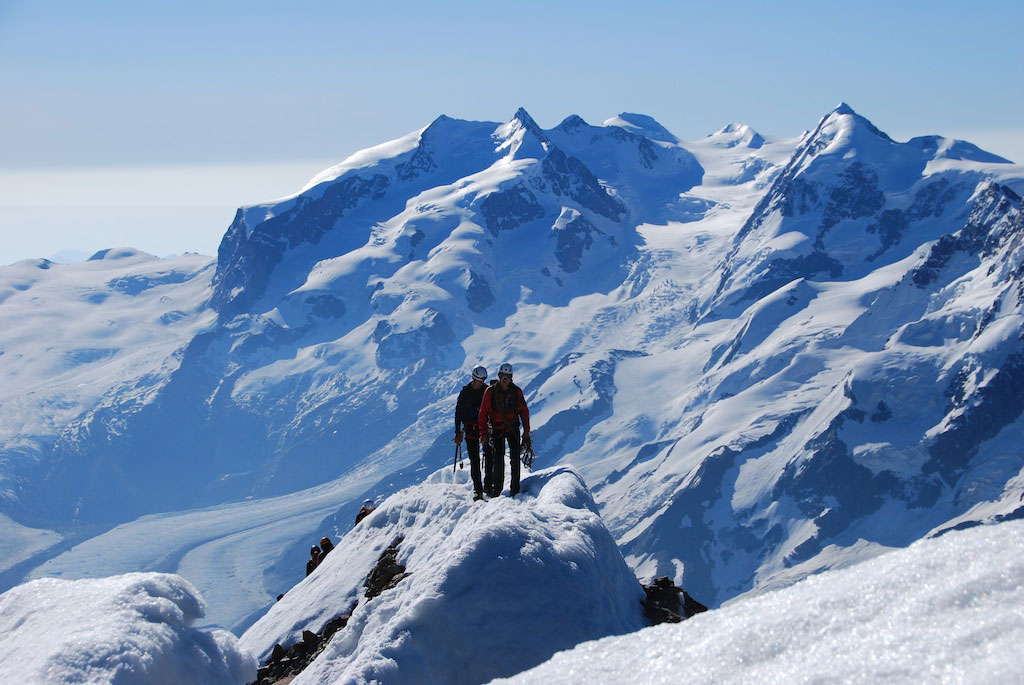
An IFMGA licensed mountain guide is a professional whose competence has been certified by an official member association, accredited by the IFMGA. They are trained and credentialed to lead, instruct, advise and coach members of the public in the four disciplines of mountaineering, ski mountaineering, rock climbing and ice climbing.
To ensure the profession is conducted as competently and responsibly as possible, the IFMGA Training Scheme sets a common framework and world-wide standard in the four disciplines.
Recognizing that individual countries often have their own individual requirements in regards to the training of their own mountain guides, a degree of autonomy exists within the IFMGA Training Scheme. While the Training Scheme covers technical skills in depth, the IFMGA places equal importance to the non-technical “soft” skills of a mountain guide. Additionally, every IFMGA licensed mountain guide is expected to observe the Code of Professional Conduct.
Any country with an existing and substantive mountain guiding association is welcome to join the IFMGA, provided it complies with the rigorous entry requirements. The IFMGA has guidelines for interested associations that details the application procedure. One of the IFMGA’s prime objectives is the free movement of mountain guides within our member countries.
In addition to training mountain guides in the core skills and techniques of mountain guiding, the IFMGA also provides courses for professionals in canyoning and rope access.
An IFMGA licensed mountain guide’s skills are recognized and transferable to many other fields inside and outside of the mountains. Many mountain guides work in rescue services, support scientific research and are specialists in avalanche safety and education.
The mountain guide’s obligation to clients is to provide them with a high-quality experience while managing risk in technical terrain. Before any guided endeavor, they provide support in the form of preparation and goal-setting to prepare and set guests up for success for a day, an objective or an expedition in the mountains. Mountain guides are well-versed in environmentally responsible practices and many have a basic education in geology, flora and fauna. Most have a deep connection and experience with the region’s mountains, history and culture.
Consequently, a guided mountain endeavor often becomes a life experience for the client. The guide not only leads the way, but is also provides coaching, advice and motivation. Mountain guides help ambitious clients improve technically and physically, often becoming life-long partners for shared objectives throughout the world. These relationships form the basis for friendships that last for a lifetime.
Safety is an important and ever-present issue in mountaineering pursuits. It is human nature to seek out recreation and adventure in the mountains, but mountaineering has risks that cannot be eliminated. IFMGA mountain guides are trained to the highest international standards in risk management, risk reduction and strategies to mitigate risk. Their high-quality education, combined with years of personal experience helps mountain guides think quickly on their feet, make decisions in a very dynamic environment and problem-solve solutions and strategies to execute the best day possible in the mountains.
Switzerland / France / Aosta Valley
No Pending Candidate Associations

